
Reinventing the Business Card


AUTHOR | Sara Loretta
PUBLISHED | March 2026
We've all done it. You meet someone interesting at an event. The conversation is good. And then comes the inevitable:
"We should stay in touch."
You pull out your phone. You scan LinkedIn QR codes. You tap "connect." You add a polite note: "Great to meet you at [event]!"
You both smile. You both feel like you did the thing.
And then... nothing.
The notification disappears into your 47 other pending requests. Their profile gets buried. You both had good intentions, but neither of you has a system for what comes next.
The business card never really died. It just got replaced with something worse. At least with paper cards, you could scribble a note on the back. "Met at SXSW…interested in automation." Context, captured. LinkedIn QR codes don't even give you that.
Sharing LinkedIn QR codes isn't networking. It's being polite. And politeness without follow-through is just noise.
The Real Problem
Connection without context is useless.
Three months from now, when you're scrolling through your contacts, you won't remember where you met them, what you talked about, or why you connected. You'll just see a name and a vague sense that you should probably send a message. But you won't. Because you don't know what to say.
The people who are genuinely good at networking follow up with intention. Not "just checking in" emails, but specific, contextual messages that reference the actual conversation:
"I thought about what you said about scaling your team; this article reminded me of your situation."
"You mentioned you were looking for a designer. I know someone who'd be great."
This kind of follow-up requires three things:
context (who they are, where you met, what you talked about),
system (a way to capture that information and surface it later), and
action (a prompt to actually do something).
Simply scanning a LinkedIn QR code gives you none of this.
Reinventing the Business Card
(For Real This Time)
Business cards were never the problem; it was what happened after the exchange. Digital business cards made the tap frictionless, but they didn't solve the real issue: the lack of infrastructure for follow-up.
We digitized the card, but we didn't digitize the follow-up system.
That's what actually needs reinventing.
That's where tools like HiHello come in; not as a replacement for business cards or LinkedIn, but as the missing layer that finally makes them work.
How a Real Follow-Up System Works
Here's the system I built to solve the missing layer that makes networking worth it and followup seamless.
Step 1: Capture context in the moment (HiHello)
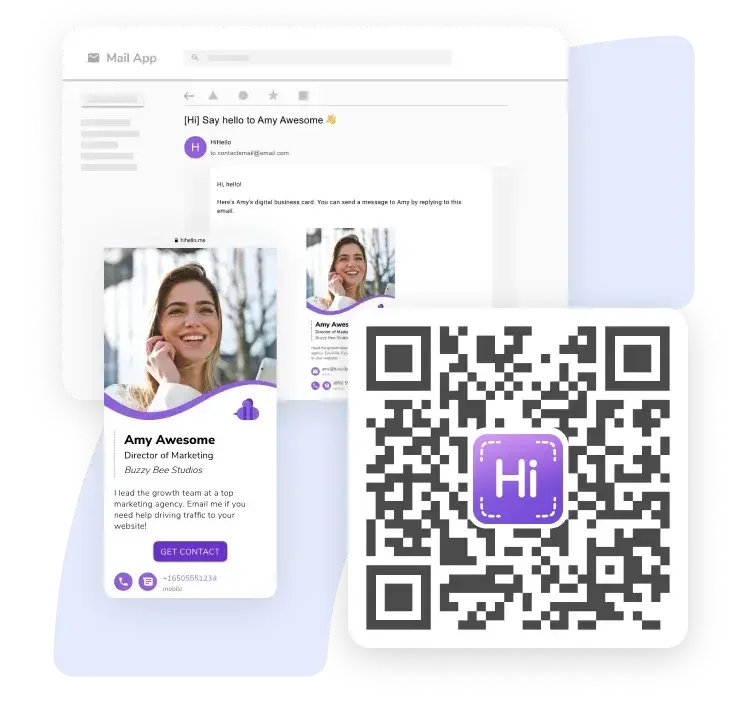
When I meet someone worth staying in touch with, I don't pull up LinkedIn. I pull up HiHello, a digital business card platform - that’s also free! - and have them scan my QR code, to save my info and share back theirs.
Step 2: Automatically route contacts to Notion (Zapier)
Immediately once the connection is submitted, Zapier sends the data to my Notion CRM, and tags them as a new connection.
The ZAP is a 2-step really simple automation:
Trigger: New contact added in HiHello
Action: Create new data source entry in Notion
I select the correct database, and update any properties, like the status so I have the right information every time.
Step 2.1: Sends my phone a notification (Notion)
I have Notion on my phone, so immediately I get a notification of the new connection. While I’m still talking to the person or quickly when we’re done, I can add notes from our conversation directly into the CRM entry.
Step 2.2: Sends email 12 hours later(Zapier)
Part of the initial automation is after sending to Notion, the automation then delays for 12 hours. After which, it sends the new connection an email, saying, “hey it was so great to meet you yesterday at XYZ (context I added to the entry manually), and chat about XYZ (context I added to the entry manually), would love to continue the conversation!”
If they respond, great. If not, it’s okay, at least I closed the loop.
Why This Works Better Than LinkedIn
LinkedIn is a directory. It's useful for looking people up, seeing who you have in common, and occasionally sending a message.
But it's terrible at helping you actually maintain relationships.
Here's what LinkedIn doesn't do:
It doesn't remind you to follow up with people you just met
It doesn't capture the context of your conversations
It doesn't surface the right contact at the right time
It doesn't track the history of your relationship
It doesn't prompt you to take action
My HiHello → Zapier → Notion system does all of this.
It's not about replacing LinkedIn. It's about having a layer underneath it that actually makes networking work.
The Follow-Up Habits That Matter
Having a system is half the battle. The other half is actually using it.
Here are the habits that make this system effective:
Capture context immediately. Don't wait until you get home. Add notes in HiHello while the conversation is still fresh. 30 seconds now saves 10 minutes of "who was this person again?" later.
Be specific, not generic. No "just checking in" emails. Every follow-up references something specific from our conversation. Even if it's just "I thought about what you said about [thing]."
Don't wait for a reason. You don't need a big update or a favor to ask. Sometimes the follow-up is just "Hey, I saw this and thought of you." That's enough, seriously, because 99% of people don’t even do this part.
Track it. After I send a follow-up, I update the contact record in Notion with the date and a quick note about what I sent. This way I'm not accidentally double-messaging someone or forgetting who I already reached out to.
What Changes When You Do This
When you have a real follow-up system, networking stops feeling performative.
You're not collecting contacts like Pokémon cards. You're building actual relationships. The kind where people remember you. The kind where they refer clients, make intros, and think of you when opportunities come up.
You stop losing track of people you genuinely wanted to stay in touch with. Because the system reminds you. It surfaces the right person at the right time.
And you stop feeling guilty about all the connections you "should" follow up with but never do. Because you're actually following up. Consistently. With intention.
Most importantly, you start seeing results. Not overnight, but over time. The person you met at a conference in March refers a client in July. The connection you made at a meetup turns into a collaboration in October. The casual coffee chat leads to a speaking opportunity six months later.
None of that happens because you scanned a LinkedIn QR code.
It happens because you built the infrastructure to turn polite exchanges into real relationships.
The System You Can Build This Week
You don't need fancy tools to make this work. Here's the simplest version:
Step 1: Download HiHello (free tier works fine). Create a digital business card. Add your contact info and a photo.
Step 2: Set up a Notion database called "People" with these fields:
Name (text = add this in Zapier from HiHello data)
Email (email = add this in Zapier from HiHello data)
Company (text)
Where We Met (text)
Notes (text)
Date Met (date = add this in Zapier as “today”)
Status (select: New Connection, Time to Followup, etc.)
Step 3: Connect HiHello to Notion via Zapier
Trigger: New contact in HiHello
Action: Create database item in Notion
Step 4: Create a Notion view filtered by "Status = New" and sorted by "Date Met."
The Real ROI of Networking
Most people measure networking by how many connections they have. How many LinkedIn followers. How many business cards collected. How many hands shaken.
But that's not the metric that matters.
The metric that matters is: how many of those connections turned into something real?
How many referrals? How many collaborations? How many conversations that actually led somewhere?
If you're networking without a follow-up system, the answer is probably "not many."
But if you build the infrastructure; capture context, automate routing, surface follow-ups, track relationships—the ROI compounds.
Because real relationships aren't built in a single conversation. They're built in the follow-up. The second message. The third touchpoint. The moment when someone realizes you're not just another person who said "let's stay in touch" and disappeared.
That's when networking becomes something more than politeness.
That's when it becomes strategy.
